A memorable Truth or Dare party depends less on decorations than on pace, fit and permission. Guests need enough structure to know what happens next, enough choice to protect their comfort and enough shared attention for every turn to matter. The host’s job is not to invent the wildest dare. It is to help a mixed group become a playful room.
The game can be the main event or a twenty-minute feature inside a larger gathering. Plan its role before buying supplies or writing prompts, because a focused short round often works better than leaving the wheel running all night.
Decide what the game is doing at the party
Use Truth or Dare as an icebreaker when many guests are meeting for the first time. Use it as a centerpiece when the guest list already enjoys party games. Use it as a late-evening option only if the group is still attentive and able to make comfortable decisions.
Write a one-sentence goal for yourself: “Help twelve birthday guests learn names and laugh together” is better than “make the party unforgettable.” The specific goal tells you to choose Party prompts, short turns and low personal intensity.
Estimate the active window too. Ten guests can usually complete two turns each in thirty to forty minutes when dares are compact. A group of twenty should split into two circles or play a shorter volunteer round rather than waiting through a long rotation.
Design the guest list and prompt set together
Consider ages, relationships, mobility, language and how well people know one another. Choose the safest set that fits every active player. Party is the default for mixed groups; Friends works when everyone shares trust and context. Kids should be used whenever children join the game.
Browse the question list in advance. Remove prompts that depend on private history, a larger room, loud sound or abilities the venue does not support. Add a few custom prompts tied to the event, such as inventing a mascot for the birthday guest or describing the party as a movie trailer. Keep custom jokes understandable and kind to everyone affected.
Do not build a guest list around assumed willingness. Someone can attend the party without joining the wheel, and a player can leave the round without leaving the social group.
Set up a room that supports attention
Arrange seats so players can see one another and the screen without forming a narrow performance corridor. Clear bags, cables, drinks and fragile objects from the active area. If movement is limited, prepare seated alternatives before guests arrive.
Place snacks and conversation areas away from the wheel when possible. People who want a break can step out without crossing the center of play. Keep music low enough that a prompt is heard once; repeating a personal question across a noisy room makes it feel more public than intended.
Use one device for the wheel and keep it with the host. Guests should not need to unlock their phones, install an app or create an account. If player names are added, ask which name each person wants displayed and reset the session after the event.
Open with a two-minute welcome
Explain the turn in plain language: the current player chooses or receives Truth or Dare, may complete it, skip it or spin again, and then play moves to the next person. State that no reason is needed for passing. Mention any event-specific boundaries, including no recording, no social posting, no contact with outsiders and no dares involving food or drink.
Then demonstrate. Give the host or a confident volunteer the first Safe prompt. If the result does not fit, use Skip casually so the feature is modeled before anyone needs it. This short example teaches more than a long speech.
Avoid asking the group to promise that “anything goes.” People cannot consent in advance to prompts they have not seen, and the phrase makes later boundaries harder to express.
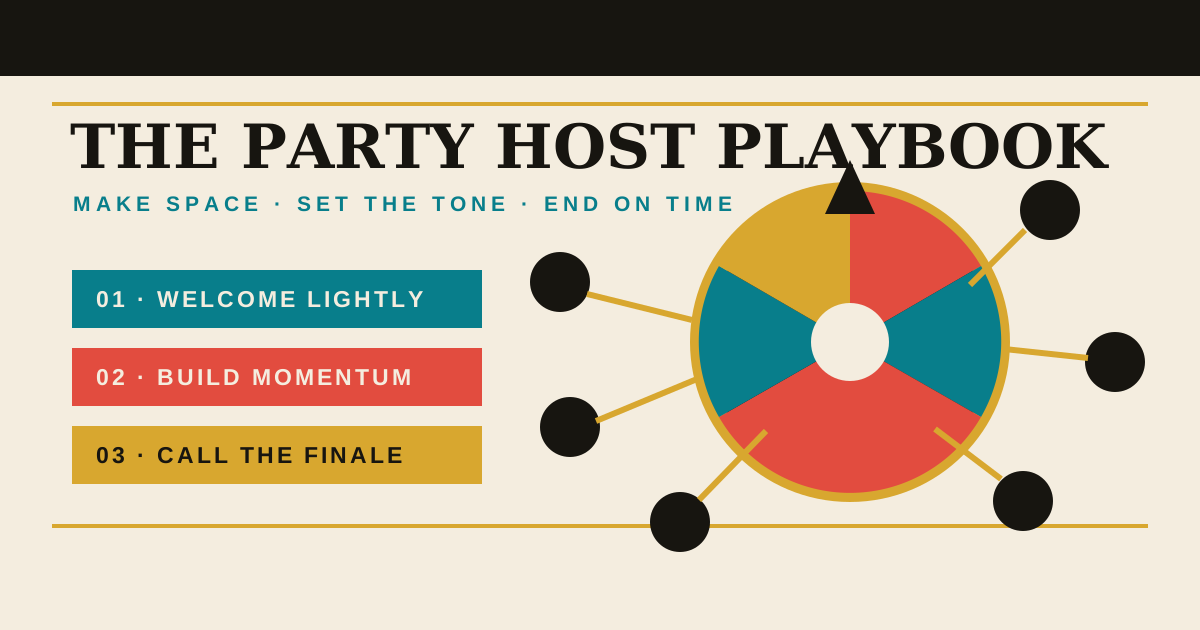
Use a three-act run-of-show
Act one is arrival. Run five to eight Safe turns that favor names, preferences, imaginary scenarios and brief performances. The purpose is participation, not revelation.
Act two is momentum. Move to Playful only after the group is responding comfortably. Alternate Truth and Dare or use Mixed mode. Keep a lively rhythm, but allow a good answer to breathe when the group is genuinely interested.
Act three is the finale. Announce the last round while attention is high. Let each current player choose the mode, or finish with a cooperative prompt such as inventing the title of the evening together. Thank the group and move clearly to the next party activity.
This shape prevents the common pattern of starting too intensely, losing quieter guests and escalating again when energy falls.
Give the host three practical jobs
First, protect the queue. Make sure turns rotate fairly and no one is volunteered by another player. Second, protect the room. Adapt dares for space, ability and current conditions. Third, protect the tone. Stop teasing after a pass and switch categories when the prompts no longer fit.
The host should not investigate discomfort in public. A neutral “next spin” is enough. If someone appears distressed, pause privately or end the game. Finishing early is good hosting when the room has changed.
For a large gathering, appoint a second host to manage names and notice people who want to enter or leave the round. Neither host should drink to the point that judgment and supervision are reduced.
Plan food, drinks and recording separately
Keep food and beverages outside the dare system. Allergies, dietary rules, medication, age and personal choice make consumption a poor random challenge. Offer normal refreshments without linking them to completion or passing.
Decide the camera policy before the game. A private performance is not permission to record it. If event photos are expected, identify the photographer and let guests opt out. Never use a surprise livestream or post as a dare.
These boundaries reduce hesitation because guests know a thirty-second silly act will remain in the room.
Recover when the energy drops
If conversation becomes flat, change format rather than increasing intensity. Try Truth only for three turns, ask players to choose between two Safe prompts, switch from Party to Friends if the room now feels closer, or take a snack break.
If one prompt causes awkwardness, skip it without debate. If several do, the category is wrong for the group. Return to a reviewed selection. If waiting time is the problem, split the circle or finish with volunteers.
A final host checklist
- The selected set fits the youngest and least familiar players.
- Everyone can pass, leave or watch without penalty.
- The active space is clear and seated alternatives are ready.
- Phones, accounts, private messages and outsiders are excluded.
- Food, drink, touch, recording and posting require separate consent.
- The host knows the final-round cue and what activity follows.
A party succeeds when guests feel more connected at the end than at the beginning. A fair, well-paced game creates that result more reliably than any extreme prompt.
Frequently asked questions
When should Truth or Dare start at a party?
Start after most guests have arrived and had time to settle, but before the room becomes too noisy or fragmented. The game works well as the first structured activity after casual introductions.
Can guests watch without playing?
Yes. Make observation a normal role and do not turn spectators into surprise participants. They may join later by asking the host.
How many custom prompts should a host add?
For a short event, five to ten reviewed prompts are enough to make the wheel feel specific. Mix them with a suitable system set so one private joke does not dominate the round.
What should happen after the game?
Move to a planned low-pressure activity such as food, music or open conversation. Reset player names and custom session data when the event uses a shared device.