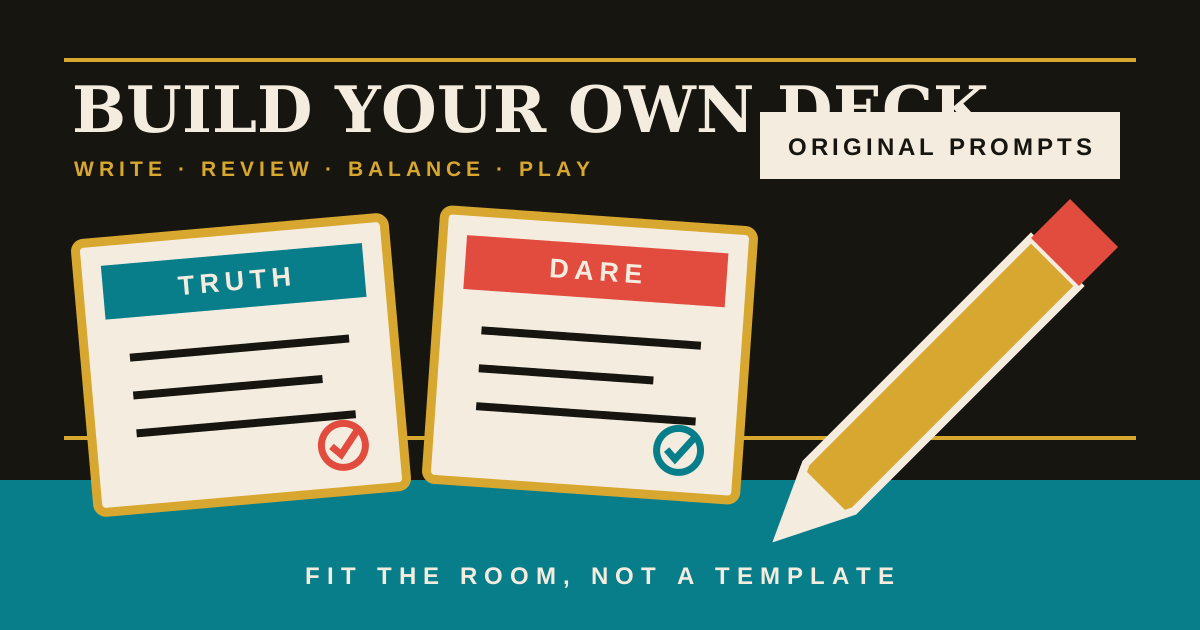
A custom Truth or Dare deck is useful when a general category is close to what you need but not specific enough. A graduation group may want shared-school memories. A reunion may want stories from different years. A date may need gentle prompts that reflect the couple’s current stage. Customization lets the host shape the conversation without changing the basic game.
The best deck is not the longest one. It is a reviewed collection with a clear purpose, varied energy and no prompt that requires the host to explain why it belongs. Start with the occasion, write more candidates than you need, then edit before placing anything on the wheel.
Write a one-sentence deck brief
Describe the people, setting and desired mood in one sentence. For example: “A twenty-minute graduation game for eight close friends, focused on shared memories and optimistic next steps.” This brief tells you more than a title such as “Graduation Dares.”
Add three constraints. The game might need to remain seated, avoid school staff and private relationships, and work without phones. Constraints help creativity because they remove ideas that would be impractical or uncomfortable at the event.
If the group contains people with different levels of familiarity, write for the person with the least shared context. An inside joke can appear only when a new guest can still understand the task and no absent person becomes the target.
Build four prompt buckets
Use four buckets to create variety. Warm-up Truths ask about preferences and easy memories. Story Truths invite a short scene, lesson or opinion. Performance Dares create a visible moment in the current room. Creative Dares ask the player to invent, draw, describe or collaborate.
For a thirty-prompt deck, a practical starting mix is:
- Eight warm-up Truths.
- Eight story Truths.
- Seven performance Dares.
- Seven creative Dares.
The mix does not need to be mathematically even. A quiet dinner may use more Truths. A birthday with energetic friends may use more Dares. What matters is that the result does not feel like the same action repeated with different nouns.
Use repeatable formulas for original Truths
Prompt formulas give you a starting structure without copying an existing list. Combine the structure with details from your event brief.
For memories, use: “Which moment from this occasion or relationship would you like to replay, and why?” For appreciation, use: “What is one contribution someone in this group makes that is easy to overlook?” For imagination, use: “If this group opened a tiny business together, what would each person do?” For future plans, use: “What is one low-cost activity this group should try in the next year?”
Each question should be answerable in a minute or two and should primarily reveal the current player’s perspective. Avoid prompts that demand another person’s secret, rank people in the room or turn a complicated relationship issue into entertainment.
Read the question aloud. If it sounds like a survey, make it more concrete. If it contains two unrelated questions, split it. If an honest answer could predictably embarrass someone who did not choose the prompt, rewrite it around the player’s own experience.
Write dares with a safe action frame
A useful dare has an action, a short duration and a clear audience. “Present a fifteen-second weather report about the party” is easier to understand than “do something funny.” Specificity reduces pressure because the player knows when the task is complete.
Try these action frames:
- Describe an ordinary object as if it were extremely valuable.
- Create a short slogan, handshake or team sound.
- Reenact a harmless shared moment using only gestures.
- Draw a symbol for the occasion with the non-dominant hand.
- Give a fictional award speech for a playful category.
Keep each dare inside the current room and under the player’s control. Exclude passwords, unlocked devices, public accounts, private messages, unwanted touch, consumption, dangerous movement and contact with people outside the game. Add a seated alternative whenever the original action assumes standing or quick movement.
Run a three-pass edit
The first edit checks fit. Does every prompt serve the deck brief? Remove generic filler that could belong anywhere if it adds no needed rhythm.
The second edit checks safety and privacy. Ask whether the prompt remains acceptable if the player passes, if another guest records it, or if the answer mentions someone outside the room. Rewrite anything that creates lasting consequences or requires separate consent.
The third edit checks variety. Circle repeated verbs such as sing, dance, reveal or imitate. Keep the strongest version and replace the rest with drawing, storytelling, teamwork, observation or imagination. Also check that the first five possible prompts are not all high-energy.
Have one person who understands the group but did not write the deck review it. Authors often know the intended meaning so well that they miss an ambiguous instruction.
Arrange a useful energy curve
Random selection means you cannot control exact order, but you can control the pool. Make roughly half the prompts Safe warm-ups, a third Playful and the remainder the group’s agreed upper intensity. A pool full of “finale” prompts has nowhere to build.
If the event has distinct phases, create two smaller decks instead of one mixed list. A reunion could begin with “Arrivals and Memories,” then switch later to “What Comes Next.” This creates a visible change in mood without escalating personal pressure.
For a very specific room, browse a matching question set first and select suitable system prompts. Add only the custom material that makes the occasion unique. Combining reviewed questions with a smaller custom layer is faster and usually more balanced than writing everything from scratch.
Add and test the deck on the wheel
Enter each custom prompt as Truth or Dare and check the wording on the same screen guests will use. Spin through a private test session. Look for text that is too long to read comfortably, instructions that need extra context and two prompts that produce the same kind of answer.
Custom prompts and player names are stored in the current browser for the local session. Do not use a shared or public device for sensitive material, and reset the session after the event. The deck should never include answers; it only contains the questions and actions needed to run the round.
During the real game, remove or skip prompts that do not fit as expected. Editing does not end when the guests arrive. A host may adapt a movement, shorten a task or change the category while preserving the playful intent.
Custom-deck checklist
Before publishing the deck to your group, confirm:
- The audience, setting, duration and mood are explicit.
- Every prompt is original or properly authorized.
- Truths focus on the current player rather than extracting someone else’s private information.
- Dares stay local, temporary and physically adaptable.
- Passing and stopping have no penalty.
- The pool contains several energies and action types.
- Another reviewer has read every prompt aloud.
Frequently asked questions
How many prompts does a custom deck need?
For a short group session, twenty to forty reviewed prompts are usually enough. Add more when you expect repeat sessions, but prioritize variety and fit over a large number.
Can I use only custom prompts?
Yes, but mixing a relevant system set with a smaller custom selection gives you an easier baseline. Test the complete pool before guests play.
Should private jokes be included?
Only when everyone affected understands the joke and is comfortable with it. Do not use the game to surprise a person with a story they did not agree to share.
How do I save a deck for another event?
Keep a clean master copy outside the live session and review it again for the new audience. Browser session data is convenient for current play, not a substitute for a deliberate editorial file.